Garment fidelity
Garment fidelity is how closely a garment in a generated or edited image matches the real product in silhouette, length, construction, colour, print, logos, hardware, texture and fine detail. The garment fidelity rate is the share of reviewed images that pass on every one of these attributes.
Garment fidelity is how closely the garment in an image matches the real product. For a generated or heavily edited image, it is the first thing to check, because an image can be sharp, well lit and on brand while showing a jacket that does not exist.
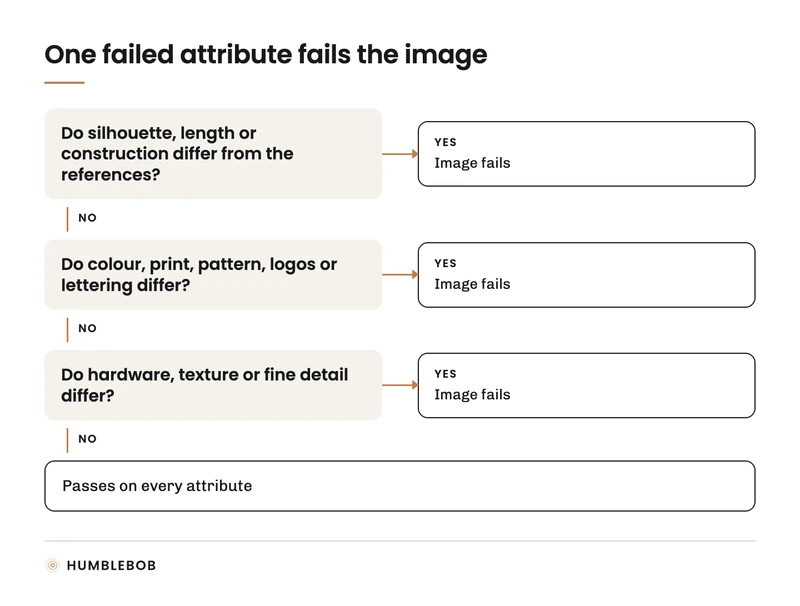
What a fidelity check covers
Compare the image with the product references on eight attributes:
| Attribute | What to look for |
|---|---|
| Silhouette and length | Where the hem, cuff and waist land on the body |
| Construction | Pockets, buttons, seams, panels, collar, closures |
| Colour | Hue, lightness and saturation against the packshot, checked with Delta E when in doubt |
| Print and pattern | Scale, placement and repeat |
| Logos and lettering | Shape, spelling and position |
| Hardware | Zips, rivets, buckles, eyelets |
| Texture | Knit, weave, sheen, wash |
| Fine detail | Stitching, labels, trims |
Five of these attributes have a named failure mode of their own: construction drift, colour shift, print drift, logo distortion and texture hallucination.
A virtual try-on paper from August 2026 scores garment fidelity with a similar breakdown, seven dimensions from silhouette and colour to logo preservation, because standard image-quality metrics struggle to measure whether a generated garment matches its reference. An image-quality score from a tool or a paper says little about whether the product is right.
How to measure it
Garment fidelity rate = images that pass on every attribute / images reviewed.
An image fails if any single attribute fails. A shirt in the right colour with an extra pocket is still the wrong product. Report the rate per category, since the typical failure differs: wash on denim, stitch structure on knitwear, scale and placement on printed tops.
For example, if 200 generated images are reviewed and 176 pass on every attribute, the garment fidelity rate is 88%. Sorting the 24 failures by attribute shows what to fix: a cluster of missing pockets, for instance, often points to a missing back or detail view in the product references. Every accepted image has to pass this check, so the fidelity rate caps the acceptance rate of the same batch.
Why it matters
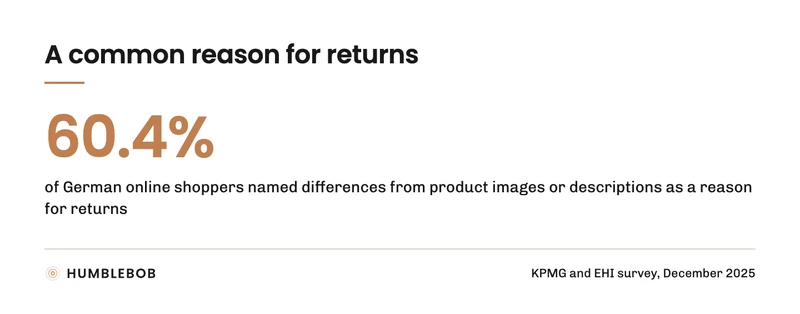
Customers order the garment in the image, and a garment that looks different in the box is a common reason for returns: in a December 2025 KPMG and EHI survey, 60.4% of German online shoppers named differences from product images or descriptions as a reason for returns. Zalando's image guidelines reserve the right to reject AI-generated images that "fail to represent the product accurately".
At HUMBLEBOB, an image that fails on any attribute is not delivered until it is fixed, usually by making it again from the references. This happens in step 3, production and feedback, of How we work.