Delta E (colour difference)
Delta E (ΔE) is the standard measure of colour difference: one number for how different two colours look. In product imagery it checks a garment's colour against its packshot and a background against its target; as a rule of thumb, a difference under 2 is hard to see without close inspection.
Delta E (written ΔE) expresses the difference between two colours as a single number, calculated from their CIELAB values so that it follows human vision more closely than a gap between hex or RGB codes. The most recent formula standardised by the CIE is CIEDE2000 (ISO/CIE 11664-6), often written ΔE00.
How big a difference is visible
A widely shared rule of thumb for Delta E values:
| Delta E | What people see |
|---|---|
| 1 or less | Not perceptible |
| 1 to 2 | Perceptible on close observation |
| 2 to 10 | Perceptible at a glance |
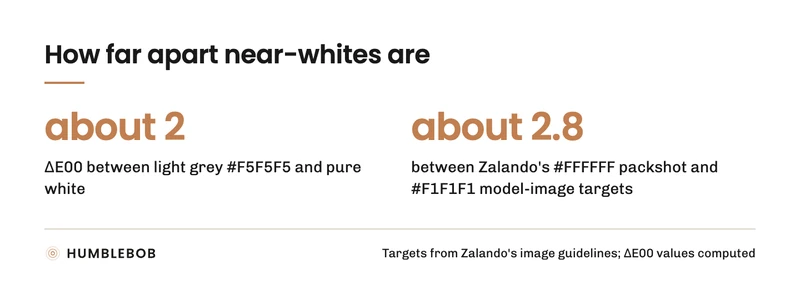
Its author calls it a general guide built from their own tests, and two colours can measure below 1 and still look different. For scale, the light grey #F5F5F5 measures about 2 in ΔE00 from pure white.
How it is used in product imagery
- Garment colour against the reference. Average a patch of flat, evenly lit fabric in the packshot, away from shadows and highlights, and the same patch in the new image; a single pixel is too noisy to judge. Both files should be in the same colour profile (sRGB for web) before the values are converted to CIELAB for the calculation.
- Background against the target. Sample the corners and edges of every image and measure against the value the channel sets. Zalando's image guidelines ask for
#FFFFFFon packshots and recommend#F1F1F1for model images; the two are about 2.8 apart, so measure a model image's background against#F1F1F1, not against white.
At HUMBLEBOB, colour comes from the packshots, never from a written description, and people review each batch against the packshots before delivery.
Limits
Delta E only compares the two samples it is given. On a worn garment, folds and shadows change the measured colour of fabric that is correct, and on a print or heathered knit one patch mixes several colours, so sample the same flat, solid area in both images and treat the number as support for the reviewer's eye. See also colour shift and background contamination.