AI fashion software or a production partner: who does the work?
Self-serve AI tools, freelancers, managed production and photoshoots compared on one question: who prepares, generates, checks, corrects and delivers.

This comparison is written by HUMBLEBOB, a production partner for fashion imagery and one of the options compared, so read it with that in mind. We compare four ways to get on-model fashion images on one question that decides most of the cost: who does the work between your product photos and a published image.
Short answer: a self-serve AI tool is the cheapest option when you have few products and someone on your team with time to review every image. A photoshoot is the best option when the story is about real people. A managed production partner fits when you have many products, recurring drops, and nobody free to prepare inputs, check garments and fix failures at volume.
Who does what
| Self-serve AI tool | Freelancer or agency using AI tools | Managed production partner | Photoshoot | |
|---|---|---|---|---|
| Prepares product inputs | Your team | Varies by contract | The partner, with your references | Your team ships samples |
| Runs generation or the shoot | Your team | The freelancer or agency | The partner | Photographer and crew |
| Checks garment fidelity | Your team | Varies; ask what is checked | The partner, then your sign-off | Your team, on set and after |
| Makes corrections | Your team | Varies by contract | The partner | Retoucher, or a reshoot |
| Keeps models consistent | Up to you | Depends on their set-up | Approved models and written rules | Rebooking the same people |
| Organises approvals | Your team | Varies | The partner runs the rounds | Your team |
| Delivers files per channel | Your team exports | Varies | The partner, per channel spec | Photographer or studio |
| Typical pricing basis | Credits or seats | Day rate or per image | Agreed per project, after a pilot | Day rates plus usage rights |
| Best fit | Small volumes, quick tests | Defined one-off projects | Large assortments, recurring drops | Hero campaigns, real people |
HUMBLEBOB is in the managed production column. Named vendors, with what each one states on its own website, are compared on AI fashion model tools compared. Providers that run the work for you are compared on managed production providers.
Where each option wins
Self-serve tools win on price per generation and on speed for small batches. They move the work to your team: preparing inputs, reviewing each output against the product, correcting failures and keeping a model consistent across images. If that team has the hours, it is often the cheapest route.
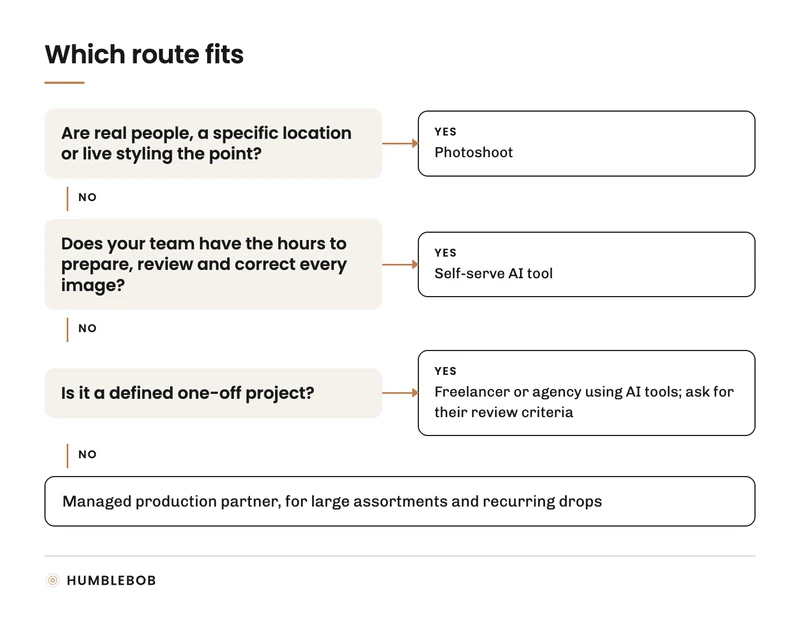
Freelancers and agencies using AI tools can be a good middle route for a defined project. What they check and fix varies a lot, so ask for their review criteria and acceptance rate before you commit.
Managed production wins when volume makes review the bottleneck. The partner carries the rejects and corrections: an image that fails review is made again before delivery. The trade-off is less day-to-day control over the tools, and a set-up phase before the first delivery.
Photoshoots win when real people, a specific location or a live styling process are the point. They need samples, a crew and a set for every shoot, and consistency across seasons depends on rebooking the same people.
Mistakes when comparing
- Comparing price per generation with price per accepted image. They measure different things; see cost per accepted image.
- Leaving out review hours. Someone has to compare every generated image with its packshot, including the ones that fail.
- Judging on showcase images. Vendor galleries show what worked, not the acceptance rate.
- Ignoring channel rules. Marketplaces set their own rules for AI images; check them before choosing a route.

Settle these before you choose
Use our pilot brief and vendor checklist to put the same questions to every option, including us, and compare the options on cost per accepted image. What HUMBLEBOB offers is set out in how HUMBLEBOB works, and how a drop runs, in five steps, on How we work.