Managed AI fashion production: who can run it for you
For brands without an internal AI team: managed services, enterprise tiers and agencies compared on what they take on, who reviews and how they price.

If nobody on your team has time to generate and check AI fashion images, you need a provider that does the work, not a tool. The options are a managed production service such as HUMBLEBOB, the enterprise tier of a self-serve platform that adds review or pass-only pricing, or an agency or freelancer working with AI tools. They differ in who checks every image against the product and in what you pay for.
Written by HUMBLEBOB, a production partner for fashion imagery and one of the options on this page, so read it with that in mind. What other companies offer is taken from their own websites, linked below and checked on 29 September 2026. Report an error to info@humblebob.com and we correct the page.
Who can run it for you
| Provider | What it says it takes on | Review, as stated | Pricing basis |
|---|---|---|---|
| HUMBLEBOB | Your brand at the start (rules, digital models, a shot list), your briefing as you send it, production, feedback and fixes, delivery per channel, and what we learn for the next drop | Each image passes a defect check, then people review each batch against your packshots and your rules before delivery | Each pilot priced per brand, with no standard rate card |
| Botika, Enterprise plan (pricing) | The self-serve platform plus a dedicated team | Review of your images by a dedicated team of experts ("white-glove quality control") | Custom |
| Photoroom, Enterprise (photoroom.com) | A self-serve platform with enterprise terms; brand rules applied on upload | Automated checks; the Enterprise Guarantee charges only for outputs that pass fidelity criteria agreed upfront | Custom |
| An agency or freelancer using AI tools | Varies by contract | Varies; ask what they check | Day rate or per image |
The self-serve tools themselves (Botika, FASHN, WearView, Uwear, Photoroom, The New Black) are compared in AI fashion model tools compared.
Questions to ask any managed provider
- Which product references do you need per item, and what happens when one is missing?
- Who checks each image against the product, against which criteria, and what happens to an image that fails: edited, or made again?
- How do you keep a model identical across a season and across seasons?
- What do we pay for: every generation, or accepted images only?
- How are images delivered per channel, and what provenance data do the files carry?
- Who owns the output, is our material used for training, and are the models based on real people?
The same questions, ready to send, are in the pilot brief.
When a managed provider is the wrong choice
- Few products. For a handful of items a season, a self-serve tool with your own review usually fits better.
- You want to run every generation yourself. Then a tool fits better than a service.
- Real people are the point. Shoot them; see what a photoshoot costs.
How HUMBLEBOB works, briefly
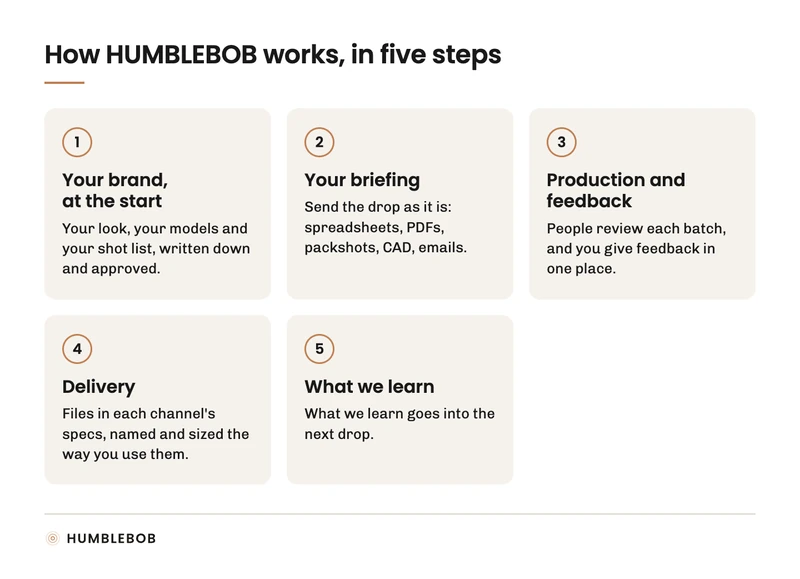
HUMBLEBOB works in five steps, set out in full on How we work:
- Your brand, at the start: HUMBLEBOB writes your look down as rules, casts your digital models and agrees the shot list per category. You approve all of it before production starts.
- Your briefing, every drop: you send the drop the way you have it (spreadsheets, PDFs, packshots, CAD, emails), and HUMBLEBOB turns it into one checked product list and asks for anything missing.
- Production and feedback: every image is made to your rules and checked for defects, and people review each batch against your packshots. You write notes in your own words in one place, and HUMBLEBOB turns them into fixes. An image is made again as a new version, and nothing is overwritten.
- Delivery: files named to your convention, in the sizes and resolutions of each channel, masters kept.
- What we learn: notes that keep coming back become rules for the next batch, and your rules, models and shot list carry over.
More on how HUMBLEBOB works. To test the fit on your own products, start with the pilot brief.