Character consistency
Character consistency is the degree to which a model looks like the same person across a set of generated fashion images: same face, skin tone, body proportions and hair. It is tracked as the character drift rate, the share of reviewed images rejected for an identity change.
Character consistency can only be judged across images. Each face in a set can look convincing on its own while the person changes from product to product, and customers see the change when they scroll a category page or click between product pages.
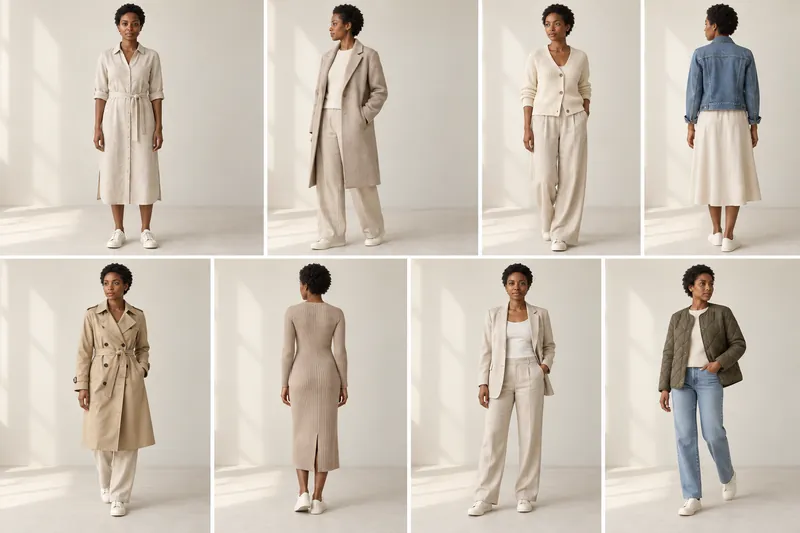
What drifts
- Face structure: eye spacing, jaw, nose width.
- Skin tone: often pulled by the light or by a strongly coloured garment near the face.
- Age: skin texture, lines and face fullness that make the model look years older or younger than the approved reference.
- Hair: length, parting and hairline, especially between front and back views.
- Body proportions: shoulders, height and build, especially under oversized fits and outerwear.
How to measure it
Character drift rate = images rejected for an identity change / images reviewed.
An identity change is a change to anything fixed when the model was approved. Hair styling, makeup and expression approved as variants of the identity do not count.
Compare every image with the approved reference set at full size, then view the finished set as a grid, the way a category page will show it. Log rejections per shot type. Back and three-quarter views tend to drift more than front views, because they show less of the face; when one model drifts on a shot type where the others hold, check whether its reference set covers that angle.
Why it matters
It is also grounds for rejection at Zalando, whose image guidelines list "inconsistent facial features, body proportions and skin tones across the same model image set" as an unacceptable distortion in AI-generated images.
The full method, from approving an identity to building a roster per segment, is in how to keep the same model across a whole collection.