Journal / Lookbooks
How to make a lookbook for a clothing brand
How to make a lookbook for a clothing brand: the reader, the look list, casting, location, a shot list per look, layout, and a look sheet you can copy.
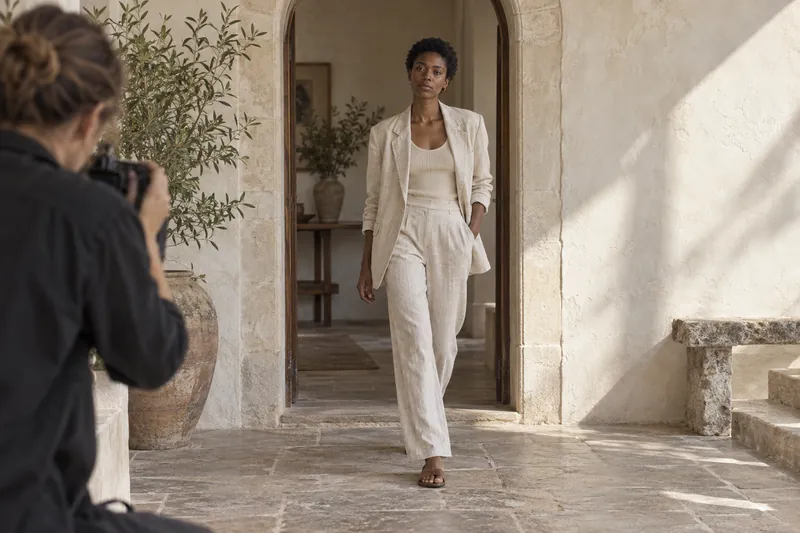
A lookbook is a set of styled outfit images that shows how a collection is meant to be worn. To make one for a clothing brand, decide first who will read it, wholesale buyers or customers. Then build a look list that covers the collection, fix the casting and the location, plan a shot list per look, produce the images, and lay them out with the product information that reader needs. The steps below follow that order, with common mistakes and a look sheet you can copy.
Read the video as text
Wholesale deadlines don't move. Decide who reads it: buyer or customer. Start from the assortment, not the moodboard. Same models, same location, same light. Buyers order the colour they see. From the HUMBLEBOB Journal.
Lookbook vs line sheet, catalogue, campaign and editorial
| Document | What it is for | Who reads it | What it contains |
|---|---|---|---|
| Lookbook | Showing the collection styled, as outfits | Wholesale buyers, press, customers | Outfit images; for buyers also style numbers and colourways |
| Line sheet | Taking wholesale orders | Retail buyers | A flat or ghost image per style, style number, colourways, sizes, wholesale and retail price, minimums, delivery windows |
| Catalogue | Selling the full range | Customers or trade | Every product with a price and a code |
| Campaign | Advertising the season | Everyone who sees your marketing | A small number of strong images around one idea |
| Editorial | Telling a story in a publication | That publication's readers | The magazine's point of view, often mixing brands |
Even the industry does not agree on these words. Wholesale platform Brandboom's glossary calls a lookbook "another term for a line sheet", while JOOR calls a lookbook "an editorial-style catalog" and a line sheet a sales tool. Settle which meaning your team uses, and make sure your buyers read it the same way.
A brand often makes all of these from one production. That works when the shot list is planned for every use from the start, and it falls apart when a campaign shoot is expected to produce a wholesale lookbook as an afterthought.
Step 1: decide who reads it
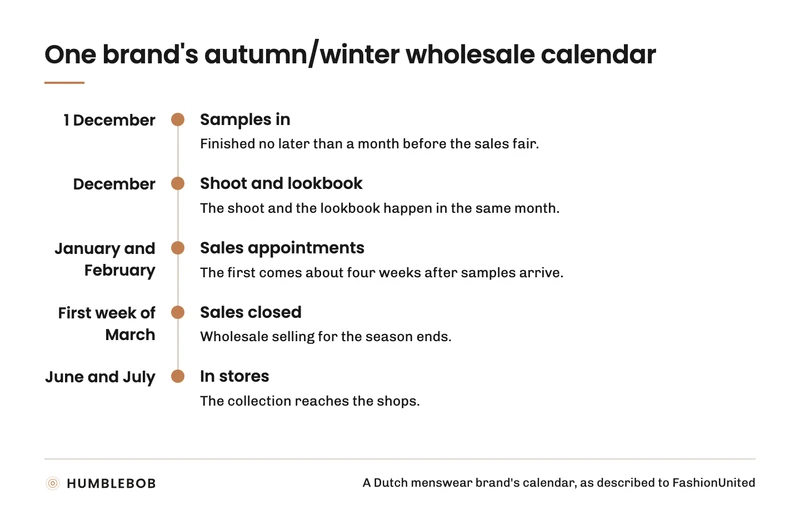
A wholesale lookbook is a sales tool. It has to be ready before the selling period, which runs months ahead of delivery. Dutch menswear brand Ampère described its autumn/winter calendar to FashionUnited: samples in by 1 December, the shoot and the lookbook in December, sales appointments in January and February, sales closed in the first week of March, and the collection in stores in June and July. That leaves about four weeks between samples and the first appointment, which matches the brand's own rule: samples finished no later than a month before the sales fair. Every look needs style numbers and colourways, so a buyer can write an order straight from the page. It usually travels as a PDF next to the line sheet, with a few printed copies for showroom appointments.
A consumer lookbook is for your customers: a page on your site, a newsletter, a social carousel. It needs fewer words and more mood, links to the products, and it goes live around the drop.
A press lookbook is for stylists and editors. It needs high-resolution downloads, clear credits and a contact for sample requests.
Pick one primary reader even when the same images serve all three. That reader sets the deadline and how much product information goes on each page.
Step 2: build the look list
Start from the assortment, not from the moodboard.
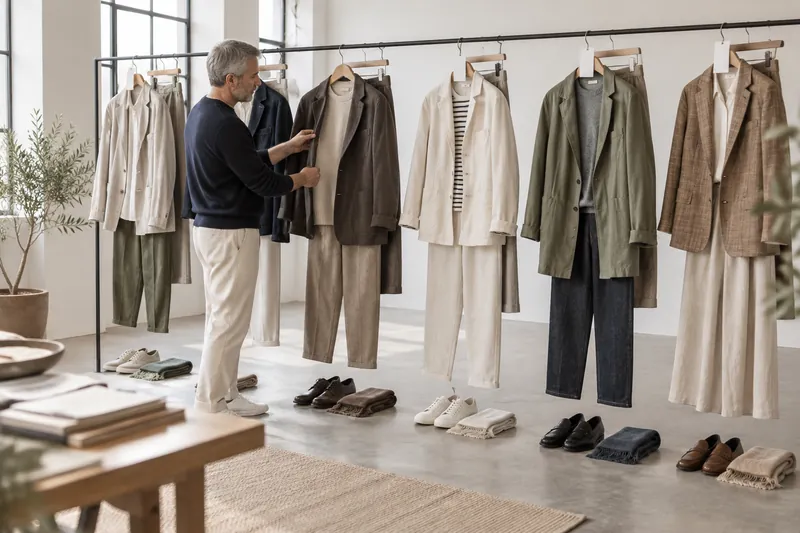
- List every style in the collection with its colourways, and mark the hero pieces.
- Group styles into outfits your customer would wear. Every style appears in at least one look, and hero pieces in more than one.
- Check the balance: count looks per category, so outerwear or denim does not take over half the book because it photographs well.
- Write down what each look must show. A jacket closed over a printed shirt hides the print, so either the jacket is worn open, the shirt gets a second look, or the shot list adds a detail.
There is no standard number of looks or pages. Printers, template sellers and imaging vendors quote anything from 8 to 40 looks and from 4 to 52 pages, none of them with data behind it. Plan the count from the assortment instead. A practical check: if a single look has to introduce more than three or four new styles, it gets crowded, and buyers will miss pieces. Add a look instead.
Step 3: fix the casting
Use the same model or models throughout, and assign them to looks on purpose. A lookbook where the face changes every few pages reads like three different brands. If you work with generated models, this matters even more, because an identity drifts unless it is fixed and checked. Our article on keeping the same model across a collection covers how.
Step 4: choose location, light and mood
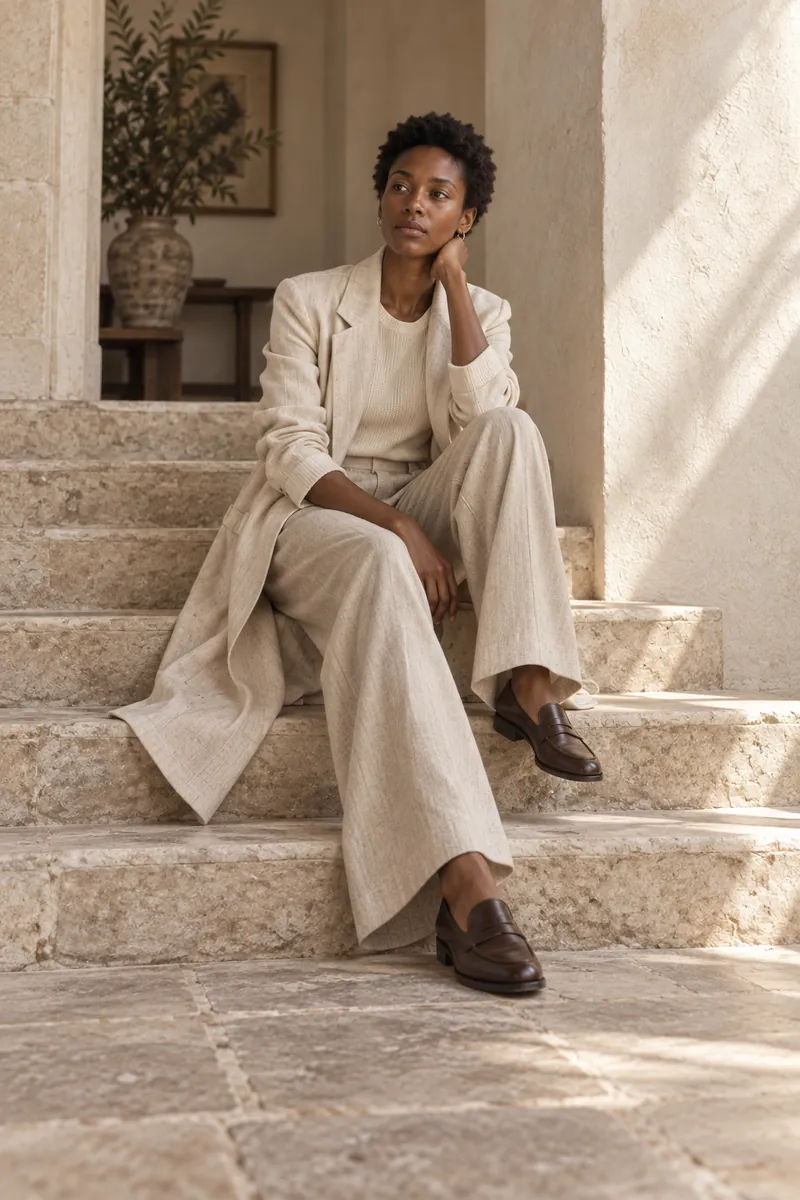
Pick one location and four or five spots inside it: a wall, a doorway, a staircase, a window. Then fix the time of day for the whole book. A colourway shot in warm late light on one page and flat noon light on the next looks like two colours, and wholesale buyers order the colour they see. For a collection with more than one story, such as a city story and a coast story, give each story its own block of pages instead of mixing them.
Step 5: plan a shot list per look, and vary it
For each look, plan at least:
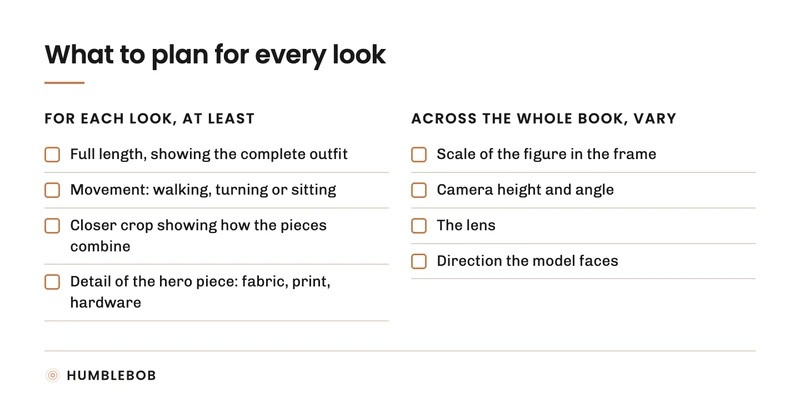
- a full-length image that shows the complete outfit,
- a movement image (walking, turning, sitting),
- a closer crop that shows how the pieces combine,
- a detail of the hero piece: fabric, print, hardware.
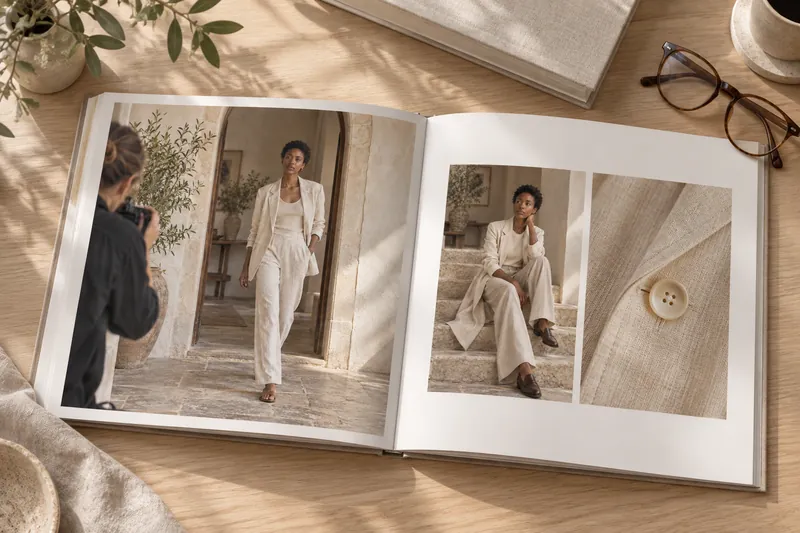
Then plan the variety across the whole book. Change the scale of the figure in the frame, the camera height and angle, the lens, and the direction the model faces. Forty centred, full-length, eye-level frames read as a catalogue. Brief every frame separately for that reason, each with its own crop, angle and direction.
Step 6: lay it out
- Open strong. The first spread carries the collection. Use the image that explains the season best, full bleed.
- Set a rhythm. Alternate full-page images with pairs, and give details and text their own quieter spreads.
- Keep product information in one place per look. For wholesale that means look number, style numbers, colourways and sizes, always in the same corner. For consumers a short caption and a link are enough.
- Plan the formats. A PDF for buyers, a web page, crops for social. Social feeds show portrait images shorter than an A4 page, so check that each hero image survives the crop before you place it.
- Watch the file size. Gmail caps attachments at 25 MB, and files grow by roughly a third in transit because of how email encodes them. Keep the email version under 10 MB or send a link, and keep the full-quality file for print.
InDesign and template tools such as Canva both work, as long as the grid stays fixed.
Step 7: when samples are late
Wholesale deadlines do not move when a factory is late. If samples arrive after the lookbook has to go out, you can build review-ready images from sketches, CADs, early samples or packshots, so buyers see the collection on a body in time for the selling period. Label those images clearly, so buyers know which looks show final samples and which show preproduction visuals. HUMBLEBOB makes these with CAD to image.
Common lookbook mistakes
- No product information in a wholesale book. Buyers cannot order from a mood.
- Colourways that do not match the sample. Buyers order the shade they see on the page. Check every colourway against the physical sample before the PDF goes out.
- Preproduction images without a label. A buyer who orders from a visual and receives something different remembers it next season.
- A PDF too heavy to email. It bounces, and the buyer never sees the book.
- Shooting before the look list is final, then discovering missing styles in layout.
A look sheet you can copy
| Look | Styles and colourways | Hero piece | Shots | Set-up | Must be visible | Page |
|---|---|---|---|---|---|---|
| 01 | Style numbers and colours | The piece this look sells | Full length, movement, crop, detail | Location spot and light | Print on shirt, jacket worn open | Spread 2, left |
| 02 |
Fill it before production, review it with sales and design together, and keep it as the brief for every frame.
HUMBLEBOB's lookbooks and campaigns can use your product page models and garments, made from the same product references. See Lookbooks and campaigns.