Journal / Industry
AI fashion campaigns so far: what Levi's, Mango, H&M and Guess learned
Levi's, Mango, H&M and Guess all used generated models in public. What each one did, how customers and press reacted, and what it means for your brand.
Levi's corrected its AI model announcement within six days. J.Crew changed its captions to credit "digital art", and its statement never mentioned AI. Since 2023, Levi's, Mango, H&M, Guess and a handful of other fashion brands have used generated models in public, and most of them ended up explaining themselves. What the public objected to in each case says more than the images did. Below is a timeline of the public AI fashion campaigns through 2026, what each brand said afterwards, and what a brand planning generated imagery now can take from them.
Read the video as text
What people actually objected to. Levi's: generating diversity instead of hiring it. Mango: how the clothes fit real bodies. J.Crew and Guess: being found out. Say how you made it. Sources: brand statements and press coverage, 2023 to 2026.
Three different things brands did
Coverage tends to lump every case together as "AI models", but brands did three quite different things, and the public reacted differently to each.
| Approach | What it is | Examples |
|---|---|---|
| Fully synthetic people | Models who do not exist, generated for the campaign or the product page | Levi's test (announced), Mango, Guess, J.Crew |
| Digital twins with consent | Generated versions of real, contracted models who approve and are paid for the use | H&M, Zara |
| AI as art direction | Generated imagery around a product or a creative idea, without replacing a model's work | Valentino, Gucci |
The timeline
Levi's, March 2023
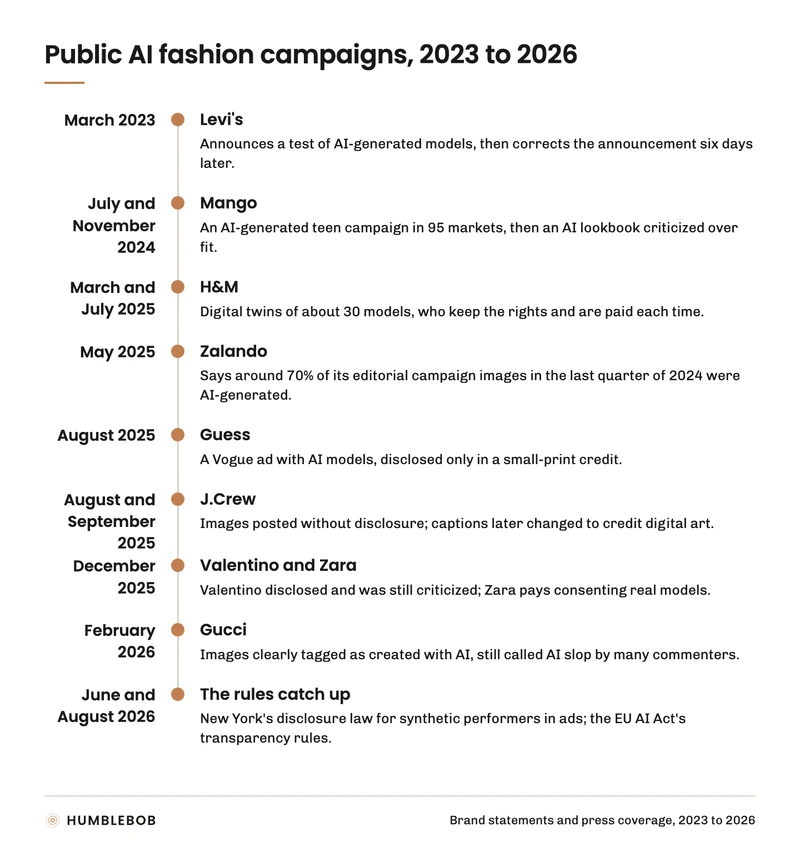
Levi's announced a partnership with Lalaland.ai to test AI-generated models "to supplement human models, increasing the number and diversity of our models". The backlash was intense, and centred on the idea of generating diversity instead of hiring diverse models. Six days later Levi's added an editor's note to its announcement: the release "did not properly represent certain aspects of the program. For that, we take responsibility." The company said it was not scaling back live shoots, live models, or its commitment to working with diverse models.
Mango, July and November 2024
Mango launched what it called its first campaign generated with AI for its teen line, in 95 markets. The garments were real and photographed; a generative model trained on those photos produced the images, which the art team then selected, retouched and finished. Later that year Mango used AI models in a teen sportswear lookbook, marked as AI-generated. On TikTok, critics called it false advertising, arguing that the AI models gave no idea how the clothes would fit a real body. Mango's CEO told Bloomberg the AI models were "about faster content creation".
H&M, March and July 2025
H&M worked with the Swedish AI company Uncut on digital twins of about 30 models. The models keep the rights to their twins and can rent them to other brands; H&M said they decide when a twin is used and are paid each time. The first images, a denim story set in fashion capitals, came out on 2 July 2025. The Model Alliance and the UK union Equity raised concerns about consent, protections and pay. The models themselves sounded pleased. "She's like me, without the jet lag," Mathilda Gvarliani said in The New York Times.
Zalando, May 2025
Zalando told Reuters that around 70% of its editorial campaign images in the last quarter of 2024 were AI-generated, cutting production time from six to eight weeks to three or four days and costs by 90%. Zalando also said it was developing digital twins of models. It is the most specific public figure we have found on time and cost, and it covers editorial campaigns. Product pages are a different job.
Guess, August 2025
A two-page Guess advertisement in the August issue of US Vogue featured AI-generated models made by the London agency Seraphinne Vallora. The only disclosure was a small-print credit ending in the words "on AI". Condé Nast stressed that this was a paid ad and that an AI model had never appeared editorially in Vogue. The criticism focused on beauty standards and on the disclosure being easy to miss. We found no public follow-up statement from Guess.
J.Crew, August and September 2025
Images for a J.Crew collaboration with Vans were posted without any AI disclosure. People online noticed models who looked different from image to image, an ankle pointing the wrong way and marks on the clothing that moved between photos. The captions were then updated to credit "digital art" by a studio, and the brand's statement did not mention AI.
Valentino and Zara, December 2025
Valentino's AI project for its DeVain bag was disclosed from the start and was still called "cheap", "tacky" and "lazy" online. Getty Images' Rebecca Swift summed it up: "Even full transparency about AI use wasn't enough to win them over." The same month, Zara confirmed it uses AI to show consenting real models in more outfits, paying them in line with industry best practice. One model said the pay matched a regular shoot.
Gucci, February 2026
Before its Milan show, Gucci posted generated images on Instagram, clearly tagged "Created with AI". They were still called "AI slop" by many commenters, with some praise mixed in.
The rules catch up, 2026
In May 2026 a model filed, and later withdrew, a lawsuit claiming a US retailer had made new AI images from an old shoot; the retailer denied it. In June, New York's law requiring advertisers to disclose synthetic performers in ads took effect. On 2 August the EU AI Act's transparency rules started to apply, covered in our article on Article 50. In the UK there is no blanket duty to disclose AI in ads, but the ASA has made clear that a disclaimer does not fix a misleading image, and in a March 2026 ruling on a dog-toy ad that showed "real and/or AI-generated puppies", it told the advertiser not to misrepresent how its products look or work. We found no ASA ruling yet on an AI model in a fashion ad.
What brands learned
Diversity cannot be generated. Levi's framed synthetic models as a way to add diversity, and the backlash was aimed squarely at that framing. Showing more body types and skin tones with generated people reads as a way to avoid hiring them.
Being found out is worse than saying it. J.Crew and Guess did not say it clearly, and people found out anyway. Marketing Brew described the cycle that followed: detection, backlash, a vague statement. In the EU, since August 2026, disclosing realistic generated people is likely a legal duty as well.
Disclosure does not buy goodwill. Valentino and Gucci labelled their images and were criticised anyway. Disclosure took the charge of deception off the table; it did nothing about the charge that the images looked cheap.
Consent and pay decide what the criticism is about. H&M's models own their twins and are paid per use; Zara says it agrees terms with its models and pays in line with industry practice. The criticism H&M drew was about protections for models and the future of their work. None of the coverage we found accused either brand of misleading customers.
Customers use images to judge the product. The Mango criticism was about fit. That is the core risk for product imagery: an image that shows a garment better than it is creates returns and complaints, whether a camera or a generator made it.
What this means for your brand
- Decide which of the three approaches you are taking before launch, and write down how the images were made, so the answer is ready and true when someone asks.
- Disclose clearly, in the place people see the image, not in small print.
- Get written consent, with scope, duration and pay, for any real person whose likeness is used or recreated.
- Keep the garment honest. Check every image against the real product before it goes live. Our checklist for AI models for clothing brands covers how to check.
- Do not use generated people to fake diversity. Cast real people when the story is about people.
HUMBLEBOB is a production partner for fashion imagery. In product page photos, lookbooks and campaigns, accuracy matters more than spectacle, so each image passes a defect check, then people review each batch against the product references before delivery. For the provenance data an image file can carry, see Content Credentials. If you already have product photos and want campaign images from them, the routes are compared in turn product photos into campaign images.