Deep fake (EU AI Act)
Under the EU AI Act, a deep fake is AI-generated or manipulated content that resembles existing people, objects, places or events and would falsely appear authentic. A photorealistic generated fashion model likely qualifies, which triggers a visible disclosure duty since 2 August 2026.
In the EU AI Act, "deep fake" is a defined legal term, and it is broader than the everyday meaning of a video that imitates a famous person. Article 3(60) of Regulation (EU) 2024/1689 defines it as AI-generated or manipulated image, audio or video content "that resembles existing persons, objects, places, entities or events and would falsely appear to a person to be authentic or truthful".
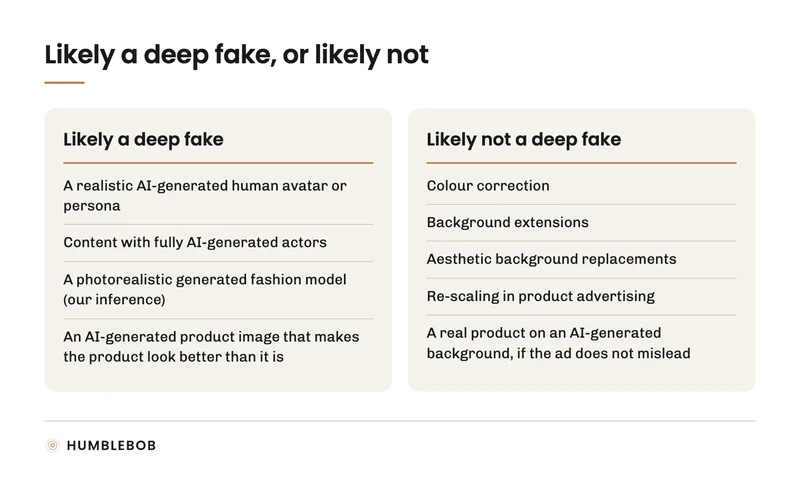
Why a generated fashion model likely qualifies
The Commission's guidelines on Article 50, adopted 20 July 2026, explain the definition:
- "Persons" include "realistic AI-generated human avatars or personas". The subject does not need to be a real, identifiable individual; it is enough that it "can plausibly exist".
- Generating essential elements, with "fully AI-generated actors" as the example, is likely to make content appear authentic.
- The test "does not require the intention of the deployer to deceive".
The guidelines contain no fashion example, so applying this to on-model product images is an inference, but a strong one.
What it triggers
Since 2 August 2026, Article 50(4) requires deployers, meaning the company using the AI system professionally, to disclose that deep fake content is artificially generated or manipulated, clearly and at the first exposure. Machine-readable metadata alone does not meet that duty.
What is likely not a deep fake
The guidelines treat colour correction, background extensions, aesthetic background replacements and re-scaling in product advertising as likely minor. A real product shown against an AI-generated background is not a deep fake as long as the ad does not mislead about the product. An AI-generated product image that makes the product look better than it is, is one.
This entry summarises the rules as of September 2026 and is not legal advice. The full picture, including who labels what in the chain from brand to agency, is in EU AI Act Article 50 and fashion e-commerce.